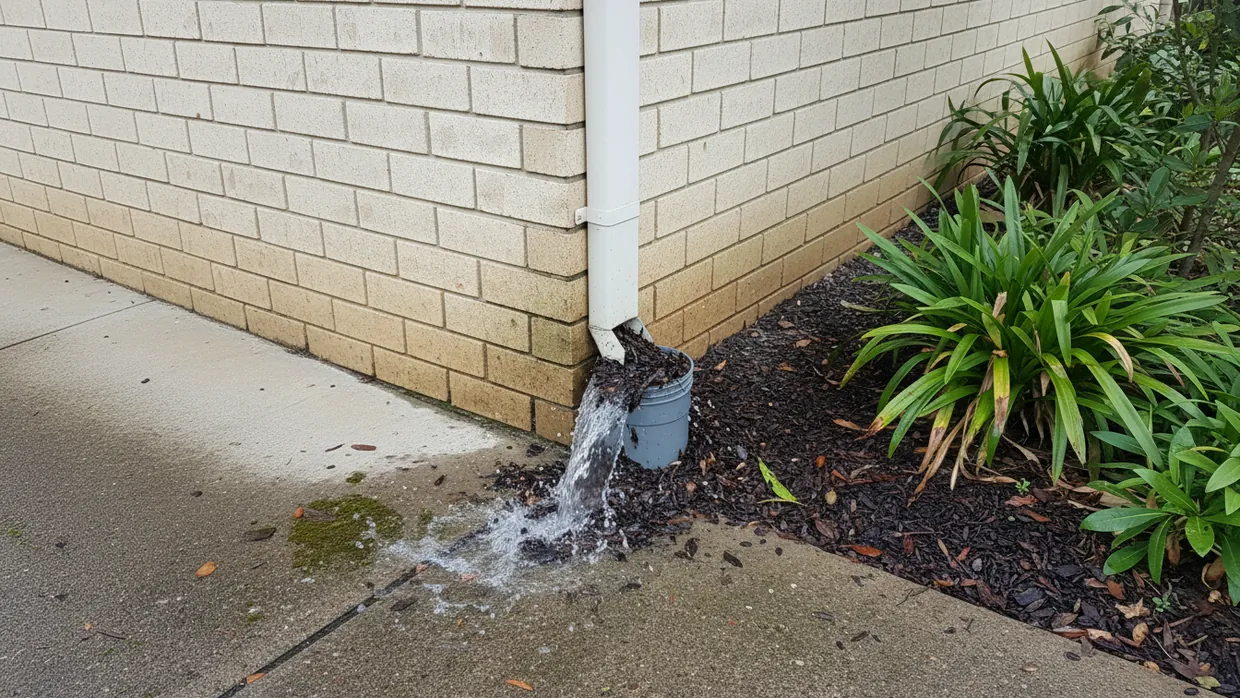
Where downpipes block
- The gutter outlet: a mat of leaves over the hole. The most common and the easiest to fix.
- The top bends, where the pipe swings in from the eave to the wall.
- The bottom bend, where leaves, seed pods and roof grit settle.
- Underground: silt, tree roots or a crushed pipe between the downpipe and the street.
- Tennis balls, birds’ nests and possum nests, usually at the top.
Clearing it safely
Ladders are the dangerous part. Set the ladder on firm, level ground, have someone hold it, and do not lean out past the side rails. On a two-storey house or a steep block, leave it to someone with the right gear.
Scoop the gutter outlet by hand, then push a hose down the pipe and turn it on. If water backs up, a plumber’s snake or a length of stiff hose worked up from the bottom often shifts the plug. Many downpipes have a joint at the base that slides apart so the bottom bend can be cleared.
When it is the underground pipe
From the downpipe, a stormwater pipe runs under the yard to the street kerb or a council drain. Tree roots get into the joints, silt settles in any dip, and pipes under driveways get crushed. A hose will not clear these.
A plumber clears the line with a high-pressure water jetter and can put a camera through it to see whether it is silt, roots or a broken pipe. If the same downpipe backs up every storm, ask for the camera: a broken pipe keeps blocking however often it is cleared.
Why it matters
A blocked downpipe turns the gutter into a bath. Water spills over the back of the gutter into the eaves and ceiling, or over the front and down beside the house. In Ipswich’s reactive clay, water soaking in beside the footings makes the ground swell and the house move, which is where cracked walls and sticking doors come from. Damp ground beside a house also suits termites.
Stopping it coming back
- Clean gutters at least twice a year: late autumn, and before the summer storms.
- Fit leaf guards over the gutter outlets, or a leaf-catching rain head on the downpipe.
- Gutter guard mesh cuts down the cleaning but does not end it. Fine debris still builds up underneath.
- Trim branches that hang over the roof.
- Never connect a downpipe to the sewer or the overflow relief gully. Roof water goes to stormwater.
Typical cost: Unblocking or replacing one downpipe is typically $150–$450. Clearing the stormwater pipe underground is typically $200–$600. See the price guide.