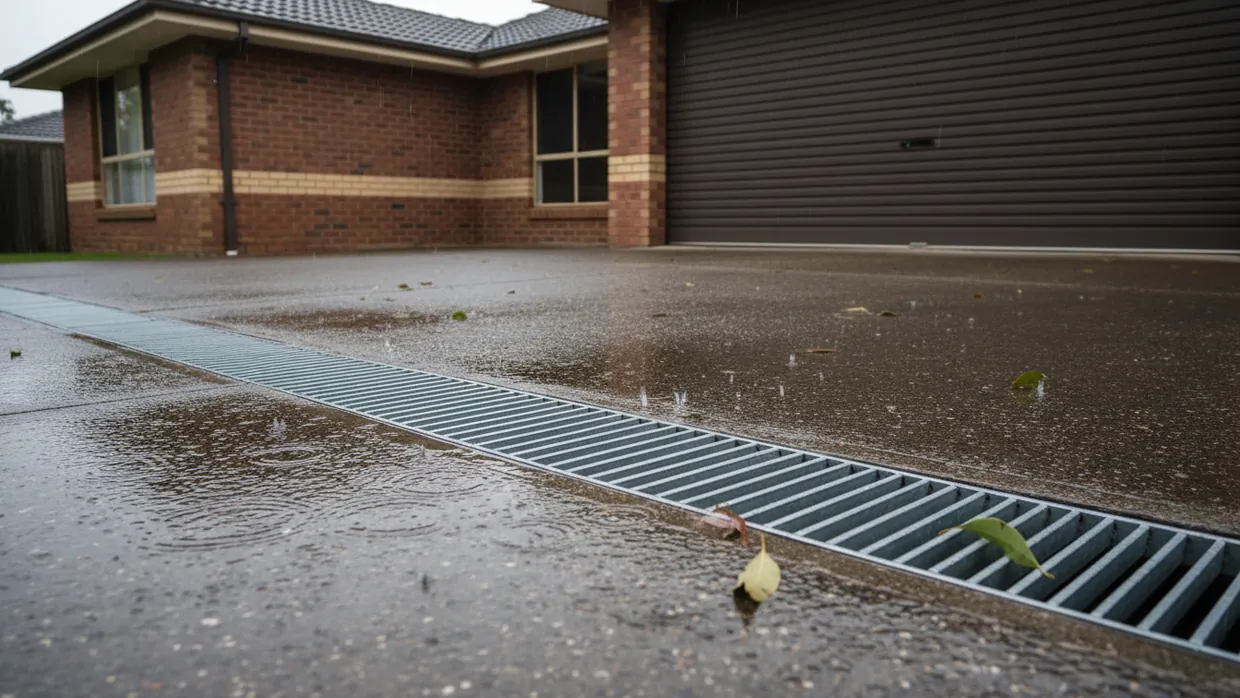
Channel drains (strip drains)
A channel drain is a narrow trough set into concrete or paving with a grate on top. It goes across the flow: along the front of a garage, at the bottom of a sloping driveway, along the edge of a patio or around a pool.
Two things decide whether it works. The grate has to suit the load: a light plastic grate is fine for foot traffic, but a driveway needs a grate and channel rated for cars. And the channel needs an outlet pipe big enough for a storm, usually 90 or 100 mm, connected to the stormwater system. A channel that overflows in heavy rain is usually full of silt and leaves, or has a blocked outlet.
Stormwater pits
A pit is a concrete or plastic box, commonly 300 to 600 mm square, set at a low point with a grate on top. Surface water falls in, and one or more pipes carry it away. Pits are also where pipes join or change direction, which makes them the place a plumber gets access to clear a line.
A good pit has a sump: the floor sits below the outlet pipe, so sand, soil and leaves settle there and stay out of the pipes. That sump fills up. Lift the grate and scoop it out before each storm season.
Soakwells and absorption trenches
A soakwell is an underground chamber, and an absorption trench is a gravel trench, that holds stormwater while it soaks into the ground. They work well in sand. Much of Ipswich is reactive clay, which takes water very slowly, so a soakwell here can fill in the first storm and then overflow for the rest of it.
They also have to sit well clear of house footings and boundaries, because soaking water into clay beside a slab makes the clay swell and the slab move. Where a kerb or council drain can be reached, that is nearly always the better outlet.
The legal point of discharge
Every property has a legal point of discharge: the place the council accepts its stormwater. It is normally the kerb and channel in the street, a stormwater pipe at the back of the block, or a council drain. Roof water and surface water must be piped there. It cannot be sent to the sewer, and it cannot be concentrated onto a neighbour’s land.
On a block that slopes away from the street, reaching it can take a pump or an easement through a lower property. The council can tell you where the point is for your address.
Looking after them
- Clear leaves off grates before the summer storms, and again after them.
- Lift pit grates each spring and scoop the silt out of the sump.
- Run a hose into each drain and check that the water gets away.
- Paving sinking beside a pit or channel can mean a broken pipe is washing soil away.
- Water standing in a pit for days, or mosquitoes breeding in it, means the outlet is blocked.
Typical cost: Clearing a blocked stormwater or outdoor drain is typically $200–$600. New channel drains are typically $50–$350 a metre. See the price guide.