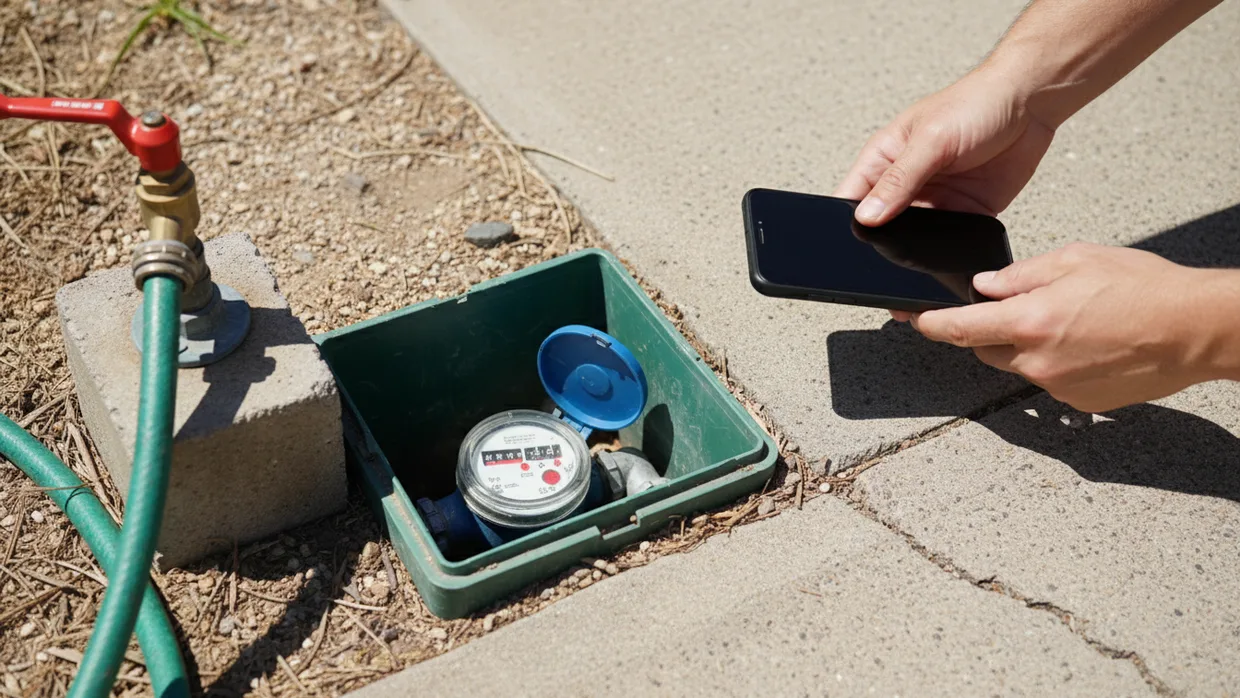
How to read your water meter: black is kilolitres.
THE SHORT ANSWER
On most water meters the black numbers count kilolitres (1 kL is 1,000 litres) and are what you are billed on. The red numbers or small dials count litres and parts of a kilolitre. Read left to right. Two readings a day apart give your daily use, and two readings 30 minutes apart with every tap off tell you whether you have a leak.
A photo of the dial is the easiest way to record a reading.
THE LEAK TEST
Test for a leak in four steps.
Turn everything off
Every tap, the washing machine, the dishwasher, the irrigation. Nobody flushes.
Photograph the meter
Get all the numbers in, black and red, and any small dials.
Wait 30 minutes
Longer is better. Overnight, with no water used, is the best test.
Photograph it again
If the red numbers or the dials have moved, water is going somewhere: you have a leak.
Finding and reading it
The meter is usually in a box in the ground at the front boundary, near a corner of the block or the driveway. Lift the lid carefully and wipe the glass. Read the black numbers from left to right: that is your reading in kilolitres. The red numbers after them are litres, which is what you watch in the leak test.
Some newer meters are digital and show one number with a decimal point: the part before the point is kilolitres.
Checking your bill
Your Urban Utilities bill shows the previous and current readings. The difference is the kilolitres you are charged for. Read the meter yourself on the day the bill arrives: if your number is lower than the "current" reading on the bill, the reading may have been estimated or misread, and it is worth a call to Urban Utilities.
Working out your daily use
Take a reading at the same time on two days. The difference in litres, divided by the people in the house, is your use per person per day. A typical South East Queensland home uses about 150 to 170 litres per person.
If the meter moved in the leak test
Turn off the stop tap at each toilet and repeat the test. If the meter now stays still, a toilet is leaking. If it still moves, the leak is in a pipe, and a plumber can find it.
Typical cost: A plumber’s visual inspection and meter test is typically $150–$300 in Ipswich. See the price guide.
Read the black numbers from left to right: that is kilolitres, the unit on your bill. The red numbers or small dials are litres and fractions of a kilolitre.
What do the red numbers on a water meter mean?+
They count litres, parts of a kilolitre. They are not used for billing, but they are what you watch during a leak test because they move first.
How do I know if my water meter shows a leak?+
Turn off everything that uses water, note the reading, and check again after 30 minutes or more. Any movement means water is escaping somewhere.
Where is my water meter?+
Usually at the front boundary in a box in the ground. In units and townhouses there is often a bank of meters near the street, each marked with a unit number.
How much does it cost to find a leak in Ipswich?+
A visual inspection and meter test by a plumber is typically $150–$300. Finding a hidden leak with detection equipment is typically $200–$500.