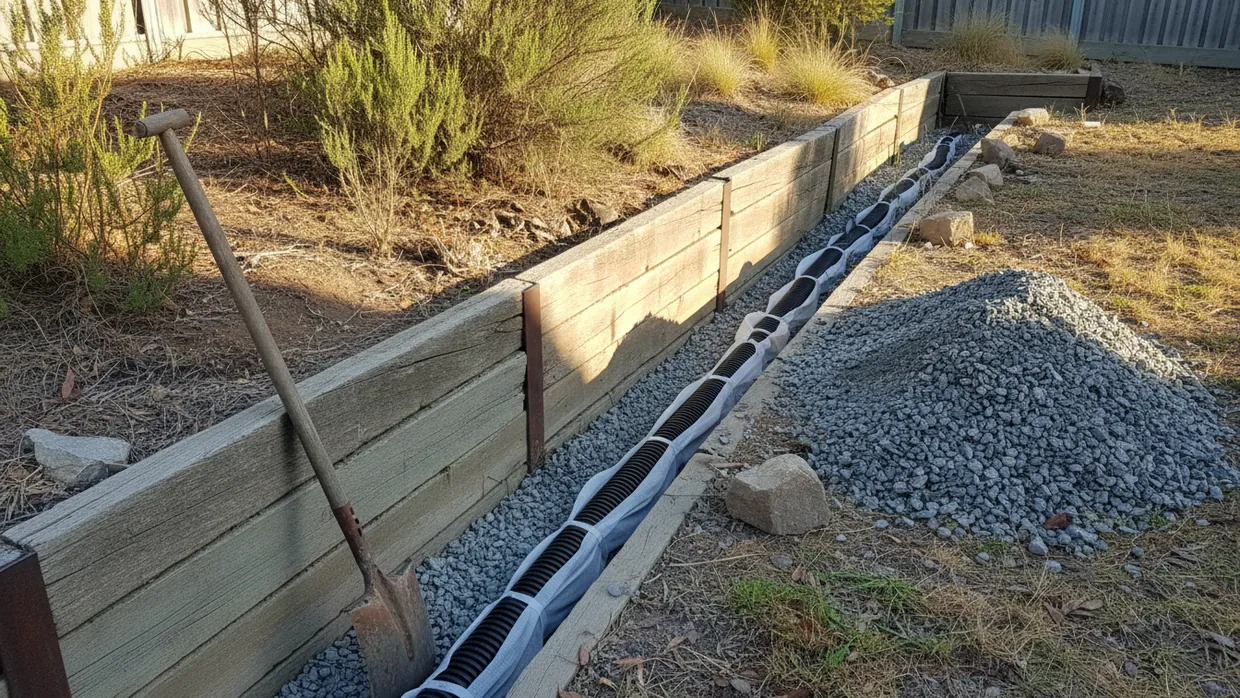
Ag pipe, French drain, subsoil drain: the same thing?
Nearly. A subsoil drain is any drain that collects water from within the ground instead of off the surface. A French drain is the classic version: a trench filled with gravel that water flows through more easily than through soil. Ag pipe is the slotted pipe that goes in the bottom of the trench so the collected water moves away quickly.
Ag pipe comes in 65 mm and 100 mm sizes, in coils, with or without a fabric filter sock. It only collects water. From the low end, a solid stormwater pipe carries the water to where it is allowed to go.
Behind a retaining wall
Soil behind a wall holds water after rain, and wet soil is far heavier than dry soil. Without drainage, that water pressure is the most common reason retaining walls lean, bulge and fail.
The usual build is ag pipe along the base of the wall on the uphill side, a column of drainage gravel at least 300 mm wide behind the wall, and fabric between the gravel and the soil. The pipe runs out past the end of the wall, or through it, to a stormwater pit. Weep holes through the face of the wall do a similar job on masonry walls.
In Queensland a retaining wall generally needs building approval and an engineer’s design if it is over one metre high, carries a load such as a driveway, or sits within 1.5 metres of a building or another wall.
Why they fail in Ipswich clay
- Silt: fine soil washes in and fills the pipe and the gravel, because no fabric was used.
- No fall: the pipe was laid flat, or has a dip that holds water and collects silt.
- No outlet: the pipe simply ends in the ground, so the trench fills up and stays full.
- Crushing: corrugated pipe under a driveway or path flattened by vehicles.
- Roots: trees and shrubs find the water and grow into the slots.
- Clay: much of Ipswich sits on reactive clay that drains slowly, so drains need to be closer together and the outlet matters even more.
Where the water has to go
A drain is only as good as its outlet. The water must end up at the legal point of discharge for the property: normally the kerb and channel in the street, or a council or rear-of-block stormwater pipe. It must not go into the sewer or the overflow relief gully, and it must not be pointed at the neighbour’s yard.
Digging a garden ag drain in your own yard is a common weekend job. Connecting it into the stormwater pipes, and any drainage behind a wall that needs approval, is work for a licensed plumber and drainer. An inspection opening at the top end lets the drain be flushed with a jetter later.
Typical cost: New subsoil, ag pipe or channel drains are typically $50–$350 a metre. Connecting to the legal point of discharge is typically $1,500–$5,000. See the price guide.