Storage tank or continuous flow?
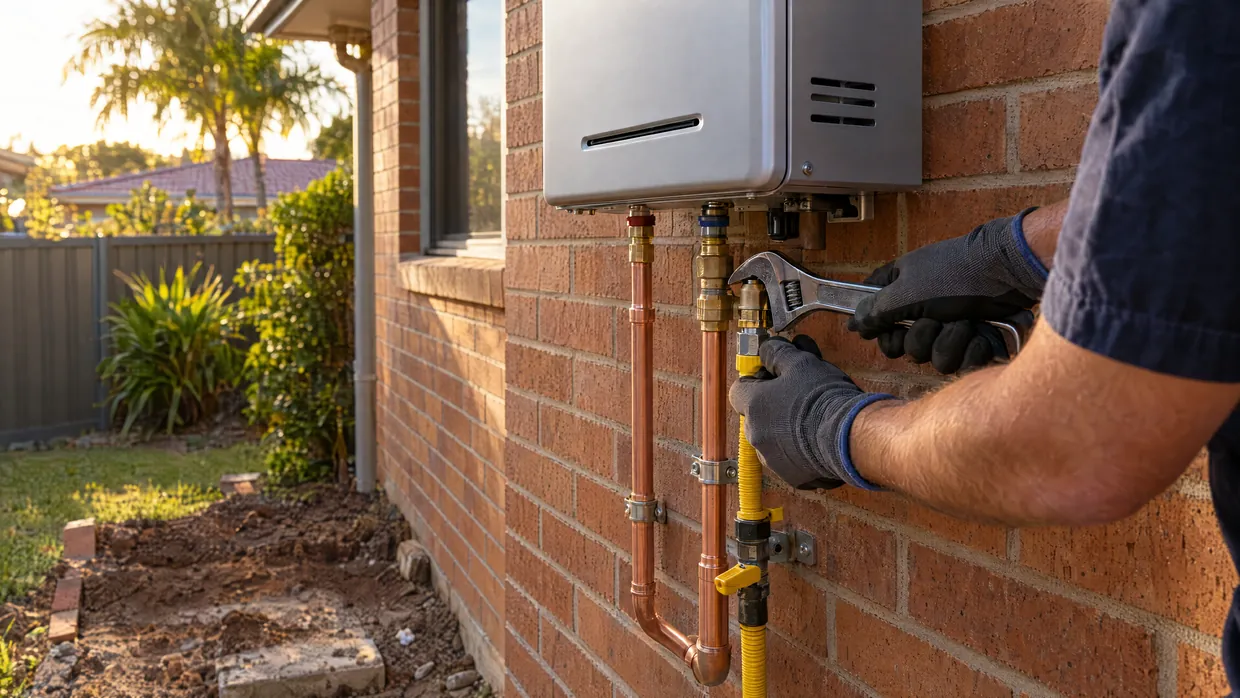
A gas storage system is a tall cylinder with a burner underneath and, on most older units, a pilot light that burns all the time. A continuous flow system (often called instant or instantaneous) is a box about the size of a suitcase on an outside wall. It has no tank and no pilot: it lights electronically when a hot tap opens, and heats the water as it passes through.
How to relight a pilot light
Follow the instructions on the unit itself, usually printed inside the access cover near the gas control. They differ between models, but the usual order is this.
- Turn the gas control knob to OFF and wait at least five minutes for any gas to clear.
- Turn the knob to PILOT and press it down to start the pilot gas.
- While holding it down, press the igniter button until the pilot lights.
- Keep the knob held down for up to a minute, then release it. The pilot should stay lit.
- Turn the knob to ON and set the temperature. The main burner should light with a soft whoosh.
If you smell gas at any point, stop and follow the steps in the gas smell guide. If the pilot will not light or will not stay lit after two tries, leave it off and call a gas fitter.
Why a pilot light keeps going out
- A worn thermocouple: the safety sensor that shuts the gas off if it cannot feel the flame. The most common cause.
- A dirty pilot jet giving a weak, yellow flame.
- Wind or a storm blowing it out, on a unit in an exposed spot.
- Low gas pressure, or an LPG bottle that is nearly empty.
- A failing gas control valve.
Continuous flow faults
- No power: a tripped safety switch, a faulty power point, or the plug knocked out.
- An error code: ignition failure, a flame sensor, a fan or overheating. The code narrows it down.
- Water goes hot then cold: the flow is too low to keep the burner lit, often from a water-saving shower head or a tap opened only slightly.
- Hot water fades when another gas appliance runs: the gas line is too small for both.
- Scale in the heat exchanger, in hard water areas.
- A blocked filter on the cold water inlet.
Repair or replace?
A gas storage tank usually lasts 8 to 12 years, and a continuous flow unit 15 to 20. A thermocouple, igniter or gas valve is worth replacing on a unit in good condition. A storage tank that is leaking from the body, or any unit past its expected life with an expensive fault, is usually better replaced.
All gas work in Queensland is licensed work. A sooty or yellow burner flame, scorch marks on the unit or a gas smell mean it should be turned off until a gas fitter has checked it.
Typical cost: Replacing a gas valve, thermocouple or igniter is typically $250–$600. A call-out and diagnosis is typically $90–$160. See the price guide.